Employer Views on Work-Based Learning: What They Value and What Would Help Them Scale




Summary
Students who participate in work-based learning earn more after graduation and are more likely to land jobs that make full use of their degrees. Nearly every employer that offers work-based learning calls it worthwhile.
Yet the number of students seeking out work-based learning (such as internships, apprenticeships, co-ops, clinicals, and practicums) exceeds the number of opportunities available, and fewer than half of graduating seniors at public four-year colleges and universities complete even one paid work-based learning experience before they finish their degree.
What would it take for employers to scale work-based learning opportunities so that every learner has the opportunity to have a structured experience that connects what they learn in the classroom to the workplace?
To answer this question, Strada Institute for the Future of Work surveyed 2,500 executives and senior leaders responsible for hiring and talent decisions and asked how much they value college students’ work-based learning experience, what motivates them to offer it, how much of their workforce it currently reaches, and what stands in the way of expanding their work-based learning offerings. The data in this report are nationally representative by industry and organization size.

Key findings
When hiring entry-level roles, employers are more than three times as likely to prioritize a candidate with work experience to one distinguished mainly by GPA and academic awards.
Among employers that offer it, 96 percent describe work-based learning as somewhat or very valuable. Work-based learning is widespread among employers. Four in five employers (81 percent) offer some form of work-based learning, proof that work-based learning is a viable, scalable lever, not a niche practice.
While work-based learning participants make up 5 percent or more of the headcount for more than a quarter (29 percent) of the surveyed employers, the majority host a number equal to 4 percent or less of the total employee headcount.
Resource and operational constraints — the cost of stipends and wages, supervisor time, and administrative burden — are the most-cited barrier to expanding work-based learning (71 percent), followed by business-environment and return-on-investment concerns (58 percent) and difficulty finding candidates with the right baseline skills (50 percent).
Resource and operational support, such as financial incentives (tax credits, wage subsidies, training grants), and program design and talent-fit support, such as vetted candidate pipelines, tie as the most-cited types of support most valued.
Highlights
Asked to rate a range of factors used to evaluate entry-level candidates, 85 percent of employers called work experience the single-most factor measured, ahead of every academic credential tested. Internship or apprenticeship experience specifically was rated important by 61 percent of employers.
Important Factors When Hiring Entry-Level Candidates
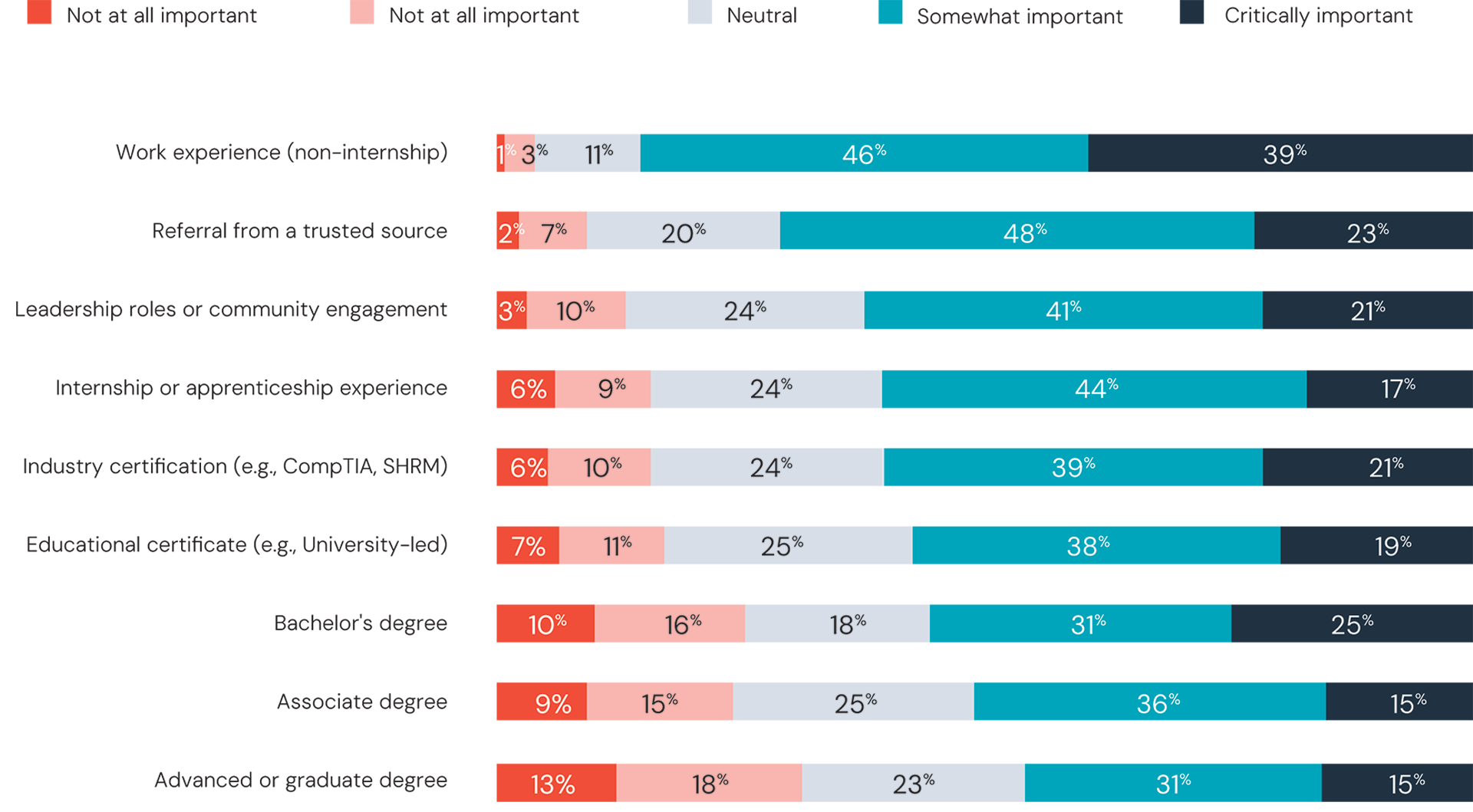
Base: Data from the March 2026 survey, weighted (n=1,498). Survey question: “When evaluating entry-level jobs, how important are the following factors?”
Primary Reason for Organization to Offer Work-Based Learning
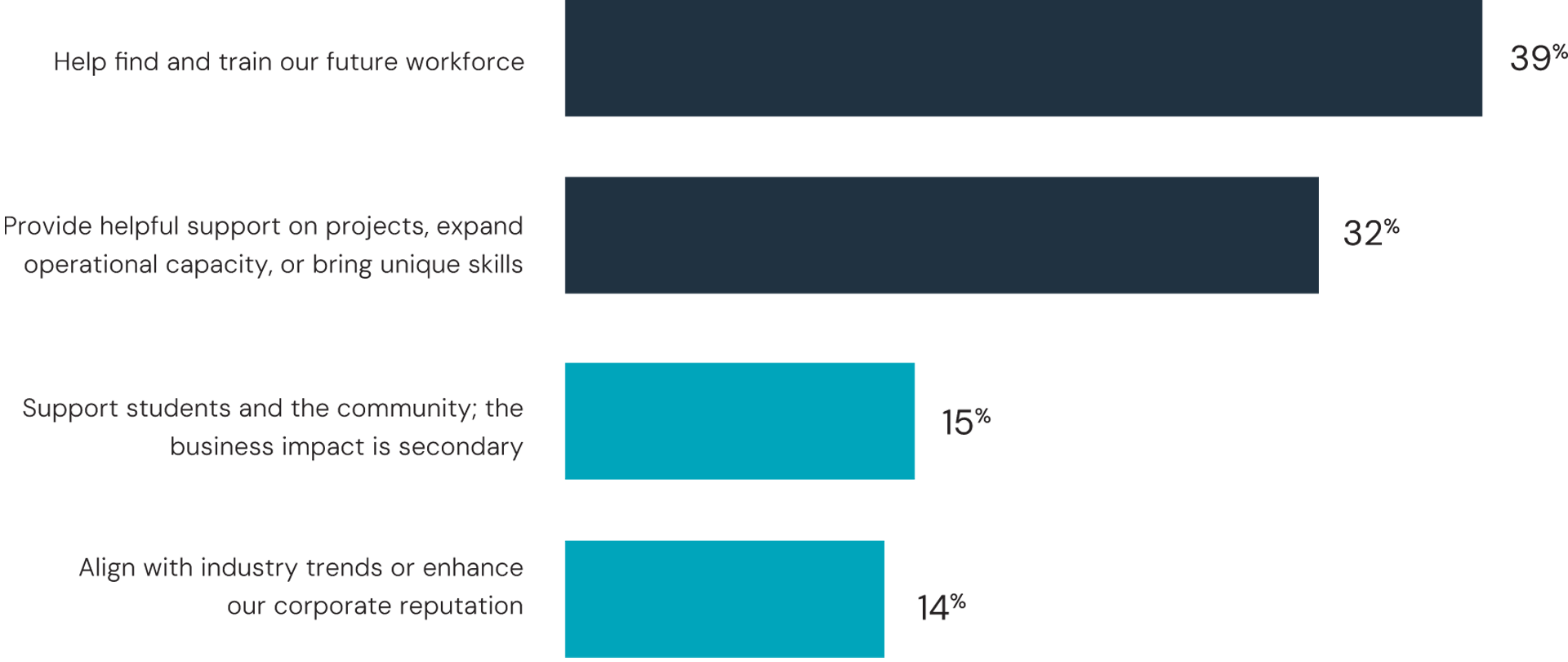
Base: Data from the March 2026 survey, weighted (n=1,226). Survey question: “If you had to choose one, which of the following most accurately describes the primary reason your organization offers work-based learning? We participate in these programs primarily to …”
Recommendations
Making work-based learning both widespread and available at a meaningful scale will require more than individual employer action. The report includes recommendations for specific stakeholder groups, including:
Employers: Assess and evaluate your portfolio of early talent programs.
Employers should assess their existing early talent programs and consider how well they are positioned to prepare future talent for their organization and industry. Business leaders should identify core challenges their talent strategy can help solve and select metrics to measure progress against those challenges over time (such as retention, engagement, productivity, etc.).
Educators and intermediaries: Build the vetted pipelines and support employers say they lack.
Respond directly by providing employers with prescreened candidate pools, preparing supervisors and mentors, assisting with program design, and managing the administrative work employers say they are not equipped to handle alone. Educators also can prepare all students for work-based learning, not just those who are already well-positioned.
Policymakers and funders: Underwrite the startup costs of scaling, not the ongoing program.
Public support can help to scale work-based learning by concentrating on the initial cost of testing and standing up a program, where the barrier to entry is highest, and can have the greatest impact when targeted at small and midsize businesses, nonprofits, and high-growth-potential industries with limited capacity to absorb startup costs on their own.