States seek ways to expand work-based learning and track it better

.jpg)
Every Wednesday morning, state leaders in Ohio who touch economic development, education, and the workforce gather to compare notes, chart their course, and act on their vision for connecting students to the workplace.
They call themselves Team Ohio.
“It’s not just a name,” said Cheryl Rice, Ohio vice chancellor of higher education workforce alignment at the Ohio Department of Higher Education. “We work together to support the talent needs and the education and training needs. We’re finding that through these collaborative conversations, we can fill gaps in multiple ways.”
Rice shared Ohio’s vision with dozens of other state leaders who gathered this spring in Washington, D.C., for a State Higher Education Executive Officers Association convening. Throughout the nation, work-based learning has emerged as a proven strategy for improving student readiness for careers, helping to ensure a return on investment in higher education, and easing access to a talent pipeline for employers in need of workers.
Last week SHEEO announced it is supporting the expansion of paid work-based learning by welcoming a 20-state coalition that will participate in a national initiative designed to help states build sustainable, scalable approaches to work-based learning and quality education-to-career coaching.
“State higher education agencies are uniquely positioned to help institutions expand access to high-quality work-based learning,” said John Lane, SHEEO vice president for academic affairs. “By strengthening the connection between education and career pathways, states can help more students engage in meaningful learning experiences and improve outcomes, especially for students who face barriers to high-quality apprenticeships, internships, and additional work-based learning experiences.”
At the convening, delegations of state higher education executive officers and workforce alignment leaders shared information about work-based learning evidence and solutions to support improved career pathway opportunities for students. Among the key pieces of advice they shared with one another:
- Designate work-based learning as an integral part of education after high school.
In Virginia, in pursuit of the state goal of expanding access to paid internships for students in postsecondary education, InternshipsVA provides resources for organizations of every size to strengthen their talent pipeline through internships. The State University of New York, with 64 campuses throughout the state, has a systemwide goal to ensure every undergraduate takes part in a paid internship or other experiential learning opportunity before they graduate.
Indiana, meanwhile, has embedded work-based learning into new high school graduation requirements. Beginning with the Class of 2029, the updated Indiana high school diploma makes internships, job shadowing, and youth apprenticeships a key part of the high school experience and exposes students to key industries and workplaces in the state.
“The diploma is no longer an end,” Paul Ketcham, Indiana assistant secretary of education, said at the SHEEO convening. “It’s a doorway to what’s next in students’ lives.”
- Reimagine connections between employers and education institutions.
One fundamental problem of making work-based learning available to more students is that too few opportunities exist. A Business-Higher Education Forum report, for example, found that in 2023, 8.2 million learners sought internships, but only 44 percent of them found one.
To cultivate more internship opportunities with employers, institutions could benefit from reviewing how they manage their current employer relationships. The Kentucky community college system took on that challenge in 2022, and the process of tracking relationships through a systemwide employer “asset map” sparked some needed operational changes and uncovered some previously unrealized opportunities.
Kentucky also has created its Kentucky Graduate Profile, a framework that defines 10 essential skills such as communication, critical thinking, and adaptability. Identifying these skills has helped students describe to potential employers how their learning translates to these skills.
“No matter a student’s major, no matter what they plan to do after college, these are the skills that set them up for lifelong success,” Miles Feroli, executive director for workforce and economic development at the Kentucky Council for Postsecondary Education, said at the SHEEO convening.
- For help creating new work-based learning opportunities, invest in intermediary organizations.
Employers, particularly at small- to medium-sized companies, often want to offer work-based learning programs but face barriers such as limited staff to manage programs and supervise learners, difficulty designing programs, challenges finding qualified candidates, and obstacles complying with labor laws and rules governing internships and apprenticeships.
Some states have found success in building relationships with employer intermediaries, organizations that bridge the gap between employers and the education and workforce systems. Indiana works with organizations such as Ascend Indiana, the statewide and Indianapolis chambers of commerce, EmployIndy, and other regional intermediaries to increase employer awareness and simplify how employers reach prospective interns.
“We’re not waiting for skilled workers; we’re building them,” said Ketcham, the assistant secretary of education in Indiana. “We’re helping them grow.”
- Measure participation and access at the institutional and state level.
Gathering data that reflect participation is one of the most difficult but essential components of prioritizing work-based learning for a state or institution.
Ohio is collecting data by requiring colleges and universities to submit a report beginning in the 2027-28 academic year. Rice, Ohio’s vice chancellor of higher education workforce alignment, said this report will include “not only how well you do, but how many students were involved? What were the businesses that were involved? How many students eventually got hired because of this relationship?”
The goal is to expand paid work-based learning well beyond the career paths traditionally associated with it, such as engineering and the medical field, to ensure all postsecondary students are benefiting from the opportunities.
“The beauty about this new policy is it’s going to be all sectors, all students moving forward,” Rice said. “The goal is to challenge institutions to increase the work-based learning opportunities that are available to students pursuing a variety of programs.”
Through the SHEEO coalition, funded by Strada, the JPMorganChase Foundation, and Ascendium, seven states and one territory will participate in an intensive learning community and will receive structured assessment, individualized technical assistance and coaching, peer learning, and support developing and advancing state-specific policy agendas. Participants in the learning community are California, Hawaii, Indiana, Louisiana, New York, Northern Mariana Islands, Ohio, and Rhode Island.
An additional 12 states — Kentucky, Maryland, Massachusetts, Mississippi, New Jersey, North Carolina, Oklahoma, Pennsylvania, South Carolina, Tennessee, Virginia, and Washington — will attend the in-person convening and monthly webinars, and will receive technical assistance in work-based learning and education-to-career guidance strategies.

By providing insight into employment opportunities, earnings, and workforce demand, labor market information helps students understand how educational pathways most consistently connect to career outcomes. This qualitative research is based on in-depth qualitative interviews with career services professionals and undergraduate students.

These five resources were developed to provide a summary of the research behind each of the five Principles for Quality Education-to-Career Guidance.
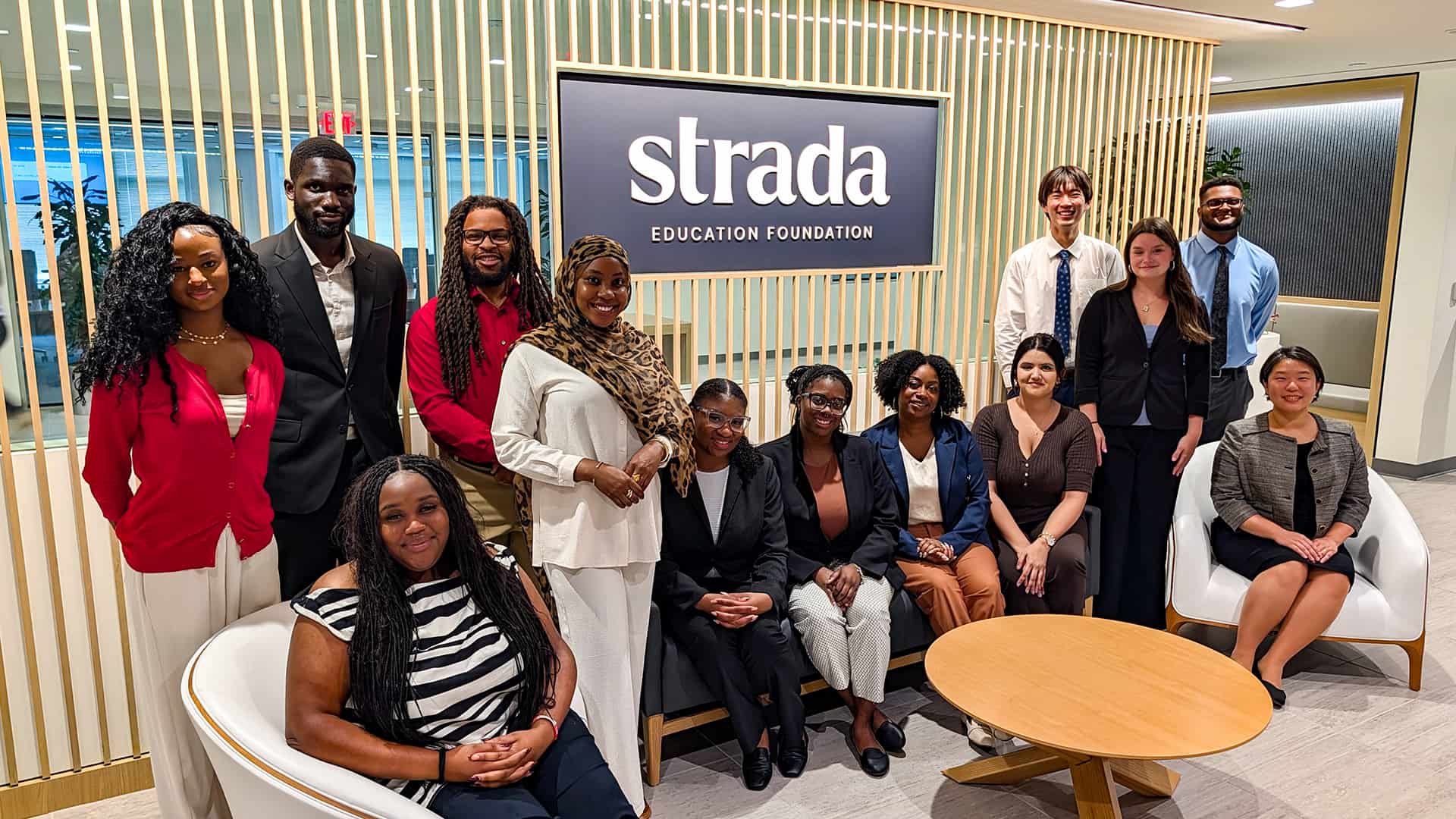
The summer 2026 Strada Education Foundation interns were exposed to the work of a national nonprofit while building skills for their future careers.

A new Strada grant aims to test and support the effectiveness of employer intermediaries, which can fill a critical gap between the learners and employers.
%20copy.jpg)
In light of what the State Opportunity Index reveals about progress in individual states and nationally, panelists will highlight practical strategies that all who seek to connect education to opportunity can apply to their work.
.jpg)
Work-based learning is linked to better early career outcomes, including higher earnings and greater likelihood of securing college-level employment. As part of the 2025 State Opportunity Index, states were benchmarked using student-reported participation in at least one of five types of paid work-based learning at public two- and four-year institutions: internships, apprenticeships, co-ops, practica, and undergraduate research experiences.

As Strada’s eight-year investment in historically Black colleges and universities reaches its halfway point, the partner institutions and students involved reflect on how it helps students connect their education to economic opportunity.
.jpg)
In partnership with Strada, an action group of intermediary organization leaders, researchers, and policy experts came together in 2025 to define and guide the practice of employer intermediaries in order to grow work-based learning opportunities.
This report provides actionable guidance for talent acquisition, learning and development, human resources, and workforce strategy leaders. It is designed for employers who already see internships as valuable, but who are seeking clearer frameworks, stronger alignment to business priorities, and more consistent ways to articulate and measure program value.
The practice of learning on the job has been around for centuries, but its capacity to prepare learners for the workforce and expose businesses to emerging talent is generating modern excitement.
.jpg)
With dedicated career coaches in 90 percent of its public high schools, the state connects learners with information about education pathways to high-demand, high-wage jobs.
The Framework for Effective Employer Intermediaries defines employer intermediaries not by organization type but rather by the functions they perform to help employers design, implement, and scale work-based learning programs.

For January’s National Mentoring Month, Strada staff reflected on how mentors in all their forms have shaped our journeys as students and professionals.

Large-scale systems-level change requires sustained attention and dedication, so when Strada looks back at progress made over the past year, we are inspired by moments that point toward a future in which every person — no matter where they start — can envision a way ahead that is filled with opportunity.

The Principles identify essential strategies for supporting students through quality education-to-career guidance as they transition from education to employment.

While overseeing the organization’s portfolio of affiliates, Cobert also leads multiyear partnerships with mission-aligned nonprofit organizations.

More than 300 education and industry leaders from 36 U.S. states came together to learn from one another about how states are connecting education after high school with economic opportunity.
.jpg)
The following organizations have endorsed the Principles for Quality Education-to-Career Guidance. We asked these organizations: How can the Guiding Principles support your work? Here are some of their responses.
.jpg)
‘For many, having someone in your corner who knows how to translate dreams into plans can make all the difference.’
A recently released Strada report analyzed survey data from seniors enrolled at public four-year universities and colleges about a portion of the universe of work-based learning experiences.
.jpg)
The components are industry leaders that have the skilled workers they need, education and training providers that understand employers’ needs, and strong collaboration between those employers and educators.

One of the most promising strategies for helping students connect their education to career opportunities is giving students the opportunity to participate in off-campus learning experiences that are aligned with their field of study. Unfortunately, these work-based learning experiences remain too scarce.
For learners, work-based learning improves access to a network, skills, and real-life work scenarios. For employers, it lowers the cost to hire and increases retention.

A new Roadtrip Nation documentary, “Rethinking Higher Ed,” asks: What is required to ensure the path provides the most value for each person? Where do students find guidance as they chose their path? How can we be sure every learner has a guide?

This year the Strada HBCU Initiative celebrates its fourth year — a milestone that includes the graduation of many students in the first cohort of Strada Scholars.

One year after its release, Strada CEO and President Stephen Moret reflects on what has been learned so far and what to expect in the next iteration.

How a student chooses a college major is often the result of personal factors, such as interests, strengths, or education and career guidance.

The institutions receiving the grants will develop innovative approaches to career services and share their knowledge and experiences with other schools.

Strada is extending an invitation for each institution to participate in the State Opportunity Index survey and to receive confidential and benchmarked results, free of cost.
.avif)
Even though internships impart a strong labor market advantage that tends to persist after graduation, the nation’s supply of internships has not kept up with demand. A new report provides insights.
.avif)
Strada’s agenda lays out ambitious steps for improving education and employment systems so students realize the economic value of their education and employers have the talent they need to fill jobs.
Guidance in connecting education to a career can make the difference in improving completion and postcompletion outcomes. When grounded in effective practices including proactive outreach and comprehensive support, coaching is associated with improved persistence and graduation rates.

Strada’s report, Quality Coaching, looks at students’ experiences across three elements of quality coaching and we examine the experiences of recent graduates. The report also offers insights to leaders, practitioners, and others seeking to improve students’ career outcomes.

Mentors in Tech, supported by a Strada grant, recruits veterans from the Seattle region’s robust tech industry to mentor students at the area’s small, affordable, open-access colleges.

The Building Better Internships report looks at the latest findings from the National Survey of College Internships, a survey developed by the University of Wisconsin-Madison’s Center for Research on College-Workforce Transitions.

Both Robinson and Love will support the foundation’s efforts to conduct research and develop policy solutions.

Through the Arizona State-led Work+Collective, more than a dozen institutions are injecting mentorship and career development skills into students’ employment.

The State Opportunity Index was developed to help states build a stronger connection between education after high school and equitable pathways to opportunity so students realize the full value of their education and employers have the workforce they need to fill high-demand jobs.

The gift of time. A recognition of talent. A helping hand. How our mentors helped shape us as people and professionals. A few Strada staff members share their thoughts.

Applied connections between education and work are increasingly a part of undergraduate education in the United States.

The foundation’s president and CEO and former chancellor of the California Community Colleges explored a Strada report that captures factors that motivated recent alumni to enroll in community college.
Three-year grants awarded to four institutions will support the expansion of programs designed to help learners succeed during and after completion of their degree or credential.
The two-year grants will support proven partnerships that connect learners to education and in-demand employment opportunities and strengthen regional economies.
A new study from Strada reveals a silver lining at a challenging time in the employment world.
As the U.S. faces a dramatic period of job turnover, economic uncertainty, and postsecondary enrollment declines, employers and educators seek to find ways to meet rapidly changing education and workforce needs.
Phase 2 allows Taskforce on Higher Education and Opportunity members to seek up to $1.5 million ($6.25 million total) to expand efforts to connect education to employment.
Disparities in securing paid internships persist for women, people of color, first-generation college students, and students with low incomes — even when taking into account their fields of study.
Strada announces the winners in the initial phase of a grant challenge aimed at helping higher education institutions improve career and life opportunities for several disadvantaged populations.
The recognized economic and workforce development leader with successful tenures in Virginia and Louisiana will join the national nonprofit in January 2022.
The grant competition seeks to connect learning with employment for first-generation students, those who struggle to afford education, and students of color.