Internship offers work-based learning trifecta: skills, mentors, and compensation

England Meadows was curious about education policy and access to quality opportunities long before she was a college student studying political science. Her interest began in the passenger seat of her mom’s car, where she spent two hours a day each way commuting to school as a child growing up in Atlanta.
Her education journey required her mother to spend hours driving and compelled Meadows and her siblings to wake at 5 a.m. “Your future,” her mom would say, “is worth the distance.”
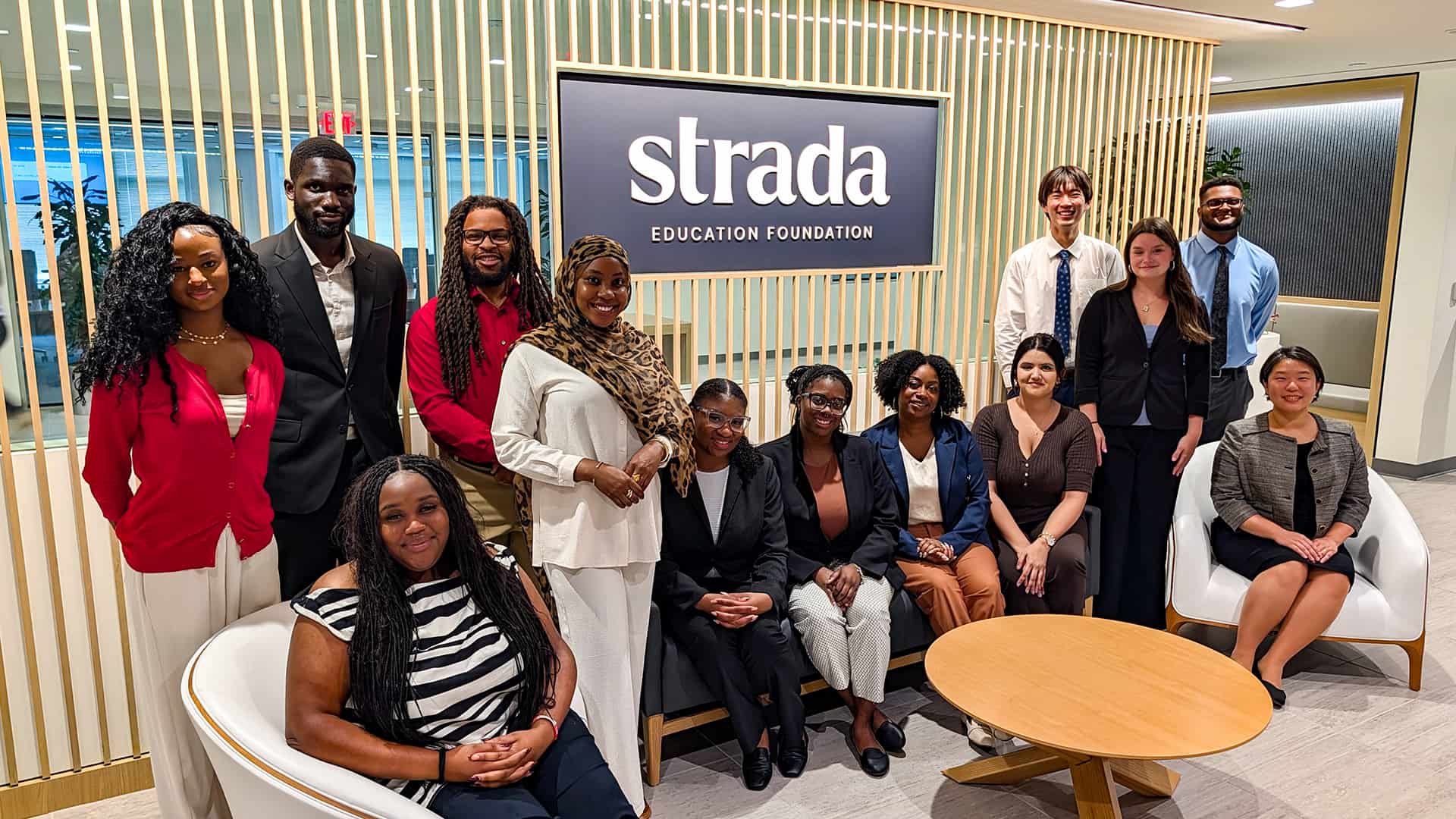
This summer Meadows, now a senior at American University, joined Strada Education Foundation as a policy intern, working on projects such as turning a static spreadsheet into an interactive policy tracker. She was among 13 interns assigned to Strada teams in the Indianapolis headquarters or the organization’s Washington, D.C., office, where they were exposed to the work of a national nonprofit while building skills for their future careers.
“When I hear education policy is about whose future we decide to invest in, that’s not just an abstract line item on a report,” said Meadows, who is majoring in political science and philosophy. “I hear my mom’s car starting up — and breaking down, sometimes.”
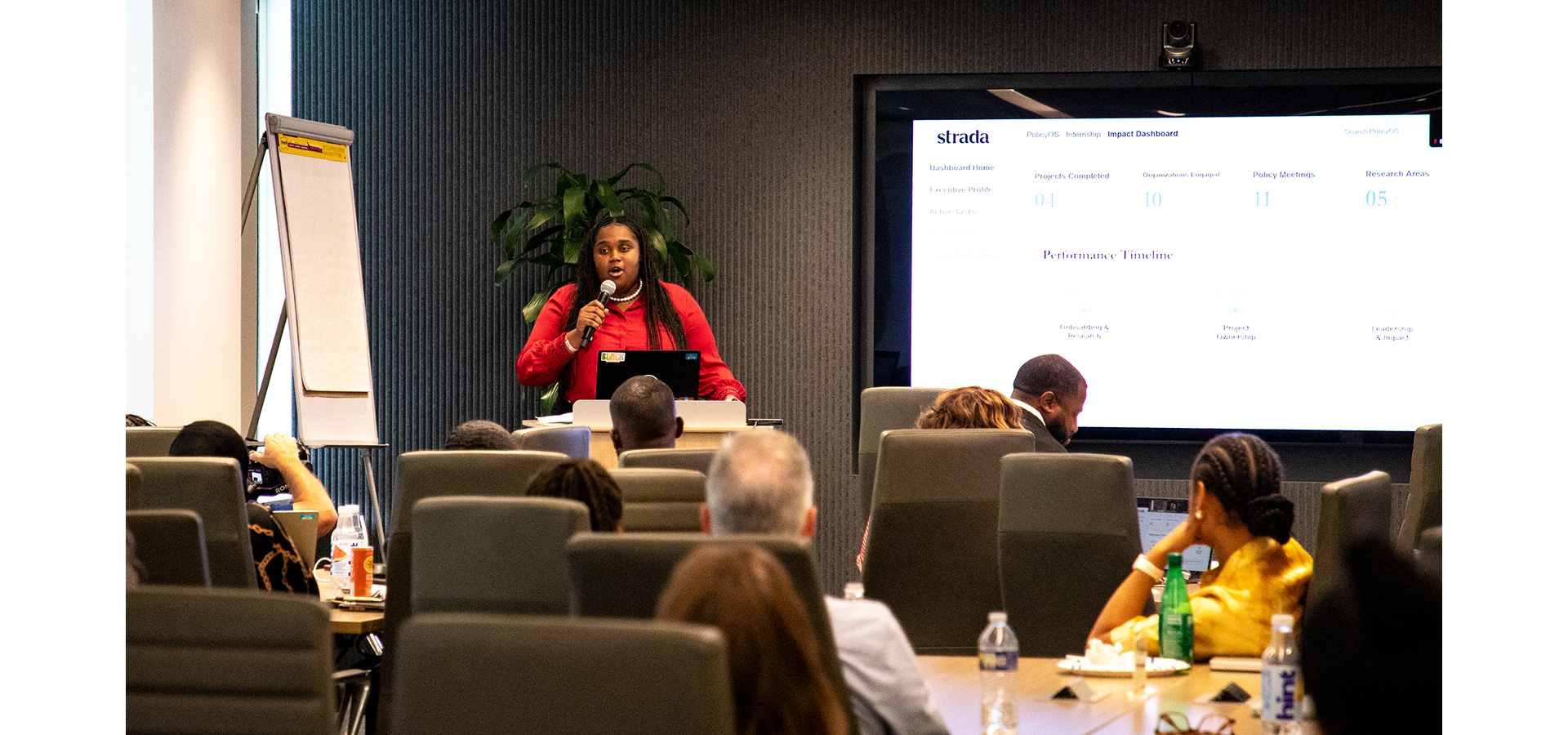
England Meadows, an incoming senior at American University,
presents to Strada staff about her experience as a policy intern at Strada.
The Strada internship program is built around the tenets of a successful work-based learning experience: It provides compensation, helps students develop professional skills, and allows them opportunities to build a professional network and access industry mentorship and social capital.
The interns also provided value for Strada. In addition to executing their individual work assignments, they delivered fresh perspectives to workplace challenges and opportunities for staff to sharpen their leadership skills by mentoring young professionals.
Strada interns also participated in weekly learning and professional development sessions, received individualized coaching from departmental colleagues as well as assigned executive mentors, and built a professional network among their peers and Strada colleagues.
“What we see and experience here is what we want employers everywhere to see,” said Chantée Eldridge, Strada senior vice president of learner engagement and chief community officer. “Conversion to full-time employment isn’t the only measure of a successful internship, and we know that students can add value with salient projects, building relationships, and increased confidence. We’re creating opportunities for learners to discover what they can become.”
According to results from a survey of interns as they entered the program and exited it, 15 percent said they arrived at Strada with a highly developed professional network, and 77 percent said they are leaving with one.
In summer 2026, Strada interns took on a number of meaningful projects within their teams. Ava Kinney, a Purdue University junior who interned with the strategic communications team, analyzed how Strada can incorporate more student voices into its content. Emma Foltz, a University of Cincinnati sophomore and human resources intern, developed a deep love of recruiting while working with the Strada talent team. William Redding, a doctoral student at the University of Georgia who joined Strada as a research intern, focused on how to be succinct and remove jargon in research writing. And Indiana University junior Gabe Burgess, an accounting intern, recorded his first debit during his internship — a milestone for any finance student.
The Strada internship program completed its third year in 2026 and is beginning to celebrate the early-career successes of past interns. This year one former intern launched her career at an international investment bank and financial services company, while another was promoted to senior auditor within two years of college graduation. One, a working mother of three, will earn her master’s degree this fall, while another became an assistant professor at a historically Black university.
Tremayne Horne, who leads the internship program as Strada program director for learner engagement and community, will soon begin recruiting interns for summer 2027.
“I challenge them a lot, pushing them to show up, participate, be accountable, and take advantage of the opportunity,” Horne said. “They rise to the challenge.”
For Meadows, the 2026 policy intern whose earliest lessons in education policy were learned on her long commute to school in Atlanta, the internship reinforced her lived experience and what she has learned in the college classroom.
“That’s why I care about higher ed so much and especially workforce policy,” she said. “Opportunity isn’t really accessible if it requires rearranging someone’s entire life in order to reach it.”
.jpg)
At a State Higher Education Executive Officers Association convening in Washington, D.C., delegations of state leaders exchanged policy developments on work-based learning evidence and solutions.

A new Strada grant aims to test and support the effectiveness of employer intermediaries, which can fill a critical gap between the learners and employers.
%20copy.jpg)
In light of what the State Opportunity Index reveals about progress in individual states and nationally, panelists will highlight practical strategies that all who seek to connect education to opportunity can apply to their work.
.jpg)
Work-based learning is linked to better early career outcomes, including higher earnings and greater likelihood of securing college-level employment. As part of the 2025 State Opportunity Index, states were benchmarked using student-reported participation in at least one of five types of paid work-based learning at public two- and four-year institutions: internships, apprenticeships, co-ops, practica, and undergraduate research experiences.

As Strada’s eight-year investment in historically Black colleges and universities reaches its halfway point, the partner institutions and students involved reflect on how it helps students connect their education to economic opportunity.
.jpg)
In partnership with Strada, an action group of intermediary organization leaders, researchers, and policy experts came together in 2025 to define and guide the practice of employer intermediaries in order to grow work-based learning opportunities.
This report provides actionable guidance for talent acquisition, learning and development, human resources, and workforce strategy leaders. It is designed for employers who already see internships as valuable, but who are seeking clearer frameworks, stronger alignment to business priorities, and more consistent ways to articulate and measure program value.
The practice of learning on the job has been around for centuries, but its capacity to prepare learners for the workforce and expose businesses to emerging talent is generating modern excitement.
The Framework for Effective Employer Intermediaries defines employer intermediaries not by organization type but rather by the functions they perform to help employers design, implement, and scale work-based learning programs.

Large-scale systems-level change requires sustained attention and dedication, so when Strada looks back at progress made over the past year, we are inspired by moments that point toward a future in which every person — no matter where they start — can envision a way ahead that is filled with opportunity.

While overseeing the organization’s portfolio of affiliates, Cobert also leads multiyear partnerships with mission-aligned nonprofit organizations.

More than 300 education and industry leaders from 36 U.S. states came together to learn from one another about how states are connecting education after high school with economic opportunity.
A recently released Strada report analyzed survey data from seniors enrolled at public four-year universities and colleges about a portion of the universe of work-based learning experiences.
.jpg)
The components are industry leaders that have the skilled workers they need, education and training providers that understand employers’ needs, and strong collaboration between those employers and educators.

One of the most promising strategies for helping students connect their education to career opportunities is giving students the opportunity to participate in off-campus learning experiences that are aligned with their field of study. Unfortunately, these work-based learning experiences remain too scarce.
For learners, work-based learning improves access to a network, skills, and real-life work scenarios. For employers, it lowers the cost to hire and increases retention.

A new Roadtrip Nation documentary, “Rethinking Higher Ed,” asks: What is required to ensure the path provides the most value for each person? Where do students find guidance as they chose their path? How can we be sure every learner has a guide?

This year the Strada HBCU Initiative celebrates its fourth year — a milestone that includes the graduation of many students in the first cohort of Strada Scholars.

One year after its release, Strada CEO and President Stephen Moret reflects on what has been learned so far and what to expect in the next iteration.

Strada is extending an invitation for each institution to participate in the State Opportunity Index survey and to receive confidential and benchmarked results, free of cost.
.avif)
Even though internships impart a strong labor market advantage that tends to persist after graduation, the nation’s supply of internships has not kept up with demand. A new report provides insights.
.avif)
Strada’s agenda lays out ambitious steps for improving education and employment systems so students realize the economic value of their education and employers have the talent they need to fill jobs.

The Building Better Internships report looks at the latest findings from the National Survey of College Internships, a survey developed by the University of Wisconsin-Madison’s Center for Research on College-Workforce Transitions.

Both Robinson and Love will support the foundation’s efforts to conduct research and develop policy solutions.

Through the Arizona State-led Work+Collective, more than a dozen institutions are injecting mentorship and career development skills into students’ employment.

Applied connections between education and work are increasingly a part of undergraduate education in the United States.

The foundation’s president and CEO and former chancellor of the California Community Colleges explored a Strada report that captures factors that motivated recent alumni to enroll in community college.
Three-year grants awarded to four institutions will support the expansion of programs designed to help learners succeed during and after completion of their degree or credential.
The two-year grants will support proven partnerships that connect learners to education and in-demand employment opportunities and strengthen regional economies.
A new study from Strada reveals a silver lining at a challenging time in the employment world.
As the U.S. faces a dramatic period of job turnover, economic uncertainty, and postsecondary enrollment declines, employers and educators seek to find ways to meet rapidly changing education and workforce needs.
Phase 2 allows Taskforce on Higher Education and Opportunity members to seek up to $1.5 million ($6.25 million total) to expand efforts to connect education to employment.
Disparities in securing paid internships persist for women, people of color, first-generation college students, and students with low incomes — even when taking into account their fields of study.
Strada announces the winners in the initial phase of a grant challenge aimed at helping higher education institutions improve career and life opportunities for several disadvantaged populations.
The recognized economic and workforce development leader with successful tenures in Virginia and Louisiana will join the national nonprofit in January 2022.
The grant competition seeks to connect learning with employment for first-generation students, those who struggle to afford education, and students of color.